MyBenefits & NYDocSubmit

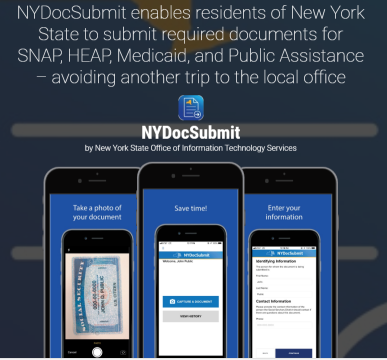
The NYDocSubmit app may save you a trip to the local social services district to provide documentation for SNAP, HEAP, Medicaid, and Public Assistance. Now, you can take a picture of a document or select a document from your mobile device, enter identifying information and submit the document to your social services district anytime. It's convenient, quick and easy. Quick Reference Card
Assistance Division
Call Center: 607‑778‑1100 (M–F 11:00 AM – 3:00 PM)
The Assistance Programs Division administers SNAP, Temporary Assistance, Medicaid, Home Energy Assistance Program (HEAP), Employment, and Daycare.
Learn more at: https://mybenefits.ny.gov/
"Skimming" Alert
The Broome County Department of Social Services has detected dozens of applications submitted by Broome County residents that their benefits were stolen due to Electronic Benefits Transfer (EBT) "skimming." This illegal process involves a device (skimmer) placed on top of a store’s card reading machine. The skimmer copies card and personal identification number (PIN) information from EBT cardholders. The stolen data is then used to access an individual’s EBT account and spend their Supplemental Nutrition Assistance Program (SNAP) and Temporary Assistance (TA) cash benefits.
How to Protect Your Benefits
- Change your PIN immediately and frequently.
- Protect your EBT card and PIN information.
- Monitor your EBT account regularly for unauthorized transactions.
- If you believe your benefits were stolen, report your card stolen by calling 888‑328‑6399, visiting ConnectEBT.com, or using the ConnectEBT mobile app.
- More information: OTDA EBT Scam Alert
- Contact the Broome County Case Integrity Unit at 607‑778‑2519.
Video: Act Fast: Protect Your EBT Benefits Against Skimming Thieves
New Common Benefit Identification Card (CBIC) Lock Feature
There is a new feature which allows households to lock their Common Benefit Identification Card, or CBIC, commonly referred to as the Electronic Benefits Transfer (EBT) card. Households will now have the ability to lock their EBT card, which prevents their Supplemental Nutrition Assistance Program (SNAP), Temporary Assistance (TA) cash benefits, and/or Home Energy Assistance Program (HEAP) benefits issued as cash to a household, from being accessed. Cardholders must then unlock the locked card to make a purchase using their SNAP or cash benefits. This new feature is intended to be used as a tool to help prevent theft of benefits through skimming or other fraudulent methods. Locking and unlocking the EBT card has no impact on Medicaid or other benefits issuances, including restricted payments directly to a landlord, utility, or other vendor.
The locking feature cannot prevent card information from being skimmed if a household’s card is used on a compromised device. However, if a card remains locked, remote fraudulent use of stolen information would be greatly restricted, limiting vulnerability to theft only at the time during which a household’s card is unlocked for purchasing.
Important Notes
- Locking does not prevent skimming if the card is used on a compromised device.
- Locked cards significantly reduce remote fraudulent use.
- Locking does not affect Medicaid or restricted vendor payments.
How to Lock/Unlock Your Card
- Use the ConnectEBT mobile app (Google Play Store or Apple App Store).
- Use the web portal: www.connectebt.com/nyebtclient/
- Call the ConnectEBT helpline at 1-888‑328‑6399 to unlock your card.
- Optional: Lock card for out‑of‑state transactions only.
Implementation
Households have the ability to lock and unlock their cards via the ConnectEBT mobile application (available on the: Google Play Store or Apple App Store). Cardholders must have a ConnectEBT account. If they have not already created an account, they can set one up using the mobile app. The cardholder must have activated their EBT card to access the lock/unlock feature. On the ConnectEBT mobile app home screen, a radio button will allow the cardholder to lock or unlock the card with one click.
Cardholders call the ConnectEBT helpline at 1-888‑328‑6399 to check the lock/unlock status and speak to a representative to unlock the card (only the unlock function is available through the helpline).
Households have the ability to perform the same locking and unlocking functions via their internet browser at www.connectebt.com/nyebtclient/.
There is an additional, and separate, locking feature to both the mobile application and the web-based client portal available, allowing households the option to lock their card for out-of-state transactions. Selecting this option will block all out-of-state transactions but continue to allow in-state transactions.
New Cards
When a new card is ordered, the system does not retain the locked status of the previous card, and all new cards are issued unlocked. Households will therefore need to relock any new cards they receive. Households are encouraged to lock their new cards immediately after selecting a Personal Identification Number (PIN). The EBT card carrier, included in new card mailings, will contain information about the card lock feature.
Transaction Types
- Rejected when locked: purchases, balance inquiries, ATM withdrawals, in‑person returns requiring a swipe.
- Allowed when locked: online returns/credits, PIN changes.
Outreach
More information: OTDA Card Lock Feature
Utilization
While card locking cannot completely prevent theft of information via skimming devices or other fraudulent methods, households whose EBT cards remain locked when not in use have a significantly lower chance of having their benefits stolen.
Requests for replacement of stolen benefits is not affected by a household’s use, or non-use, of the card lock feature.
As stated above, the card lock feature does not impact Medicaid.
SNAP
Food Stamps or SNAP (Supplemental Nutrition Assistance Program) is a federally funded program administered by the Department of Social Services for the United States Department of Agriculture. The goal of the program is to provide a higher level of nutrition to income eligible individuals and families by enhancing their ability to purchase food.
Eligibility for the program is determined by financial criteria. Those found eligible receive an EBT (electronic benefit card) which can be scanned in any of 29 local grocery stores and farmers markets in Broome County.
Temporary Assistance
Temporary Assistance provides cash benefits to eligible households. Payments may cover shelter, heat, utilities, and other essential needs.
Consumers receive a cash benefit either paid to them or to a vendor to pay for specific household needs. Household composition, resource and income levels will affect the amount of the shelter, heat, utility and other payments made for eligible families and individuals.
Medicaid
Medicaid provides necessary health care coverage to eligible low‑income adults, children, pregnant women, elderly adults, and people with disabilities in our community.
Medicaid – Nursing Home/Chronic Care
The Medicaid Chronic Care Unit determines Medicaid eligibility for individuals requiring long‑term, ongoing nursing home care. Staff review financial eligibility, process applications, and maintain ongoing coverage for individuals receiving Chronic Care services.
More information regarding Medicaid for Nursing Home/Chronic Care.
HEAP
The Home Energy Assistance Program (HEAP) helps eligible households pay for heating costs during the winter months. Staff determine eligibility, process applications, and issue benefits. HEAP benefits may help pay for electricity, natural gas, oil, propane, kerosene, wood, or other heating sources.
Employment Unit (formerly Welfare to Work (WtW))
The Employment Unit provides assessment, employment planning, job readiness classes, workfare, job placement, and case management for Temporary Assistance applicants and recipients.
Employment services are offered at the Main Street office. We strive to connect all Temporary Assistance applicants and recipients with employment opportunities to help them obtain and maintain self-sufficiency.
Additional Broome County Resources
Looking for other resources in Broome County? Click here to contact 211.
Child Abuse/Neglect Hotline
24‑Hour State Child Abuse/Neglect Hotline: 1‑800‑342‑3720